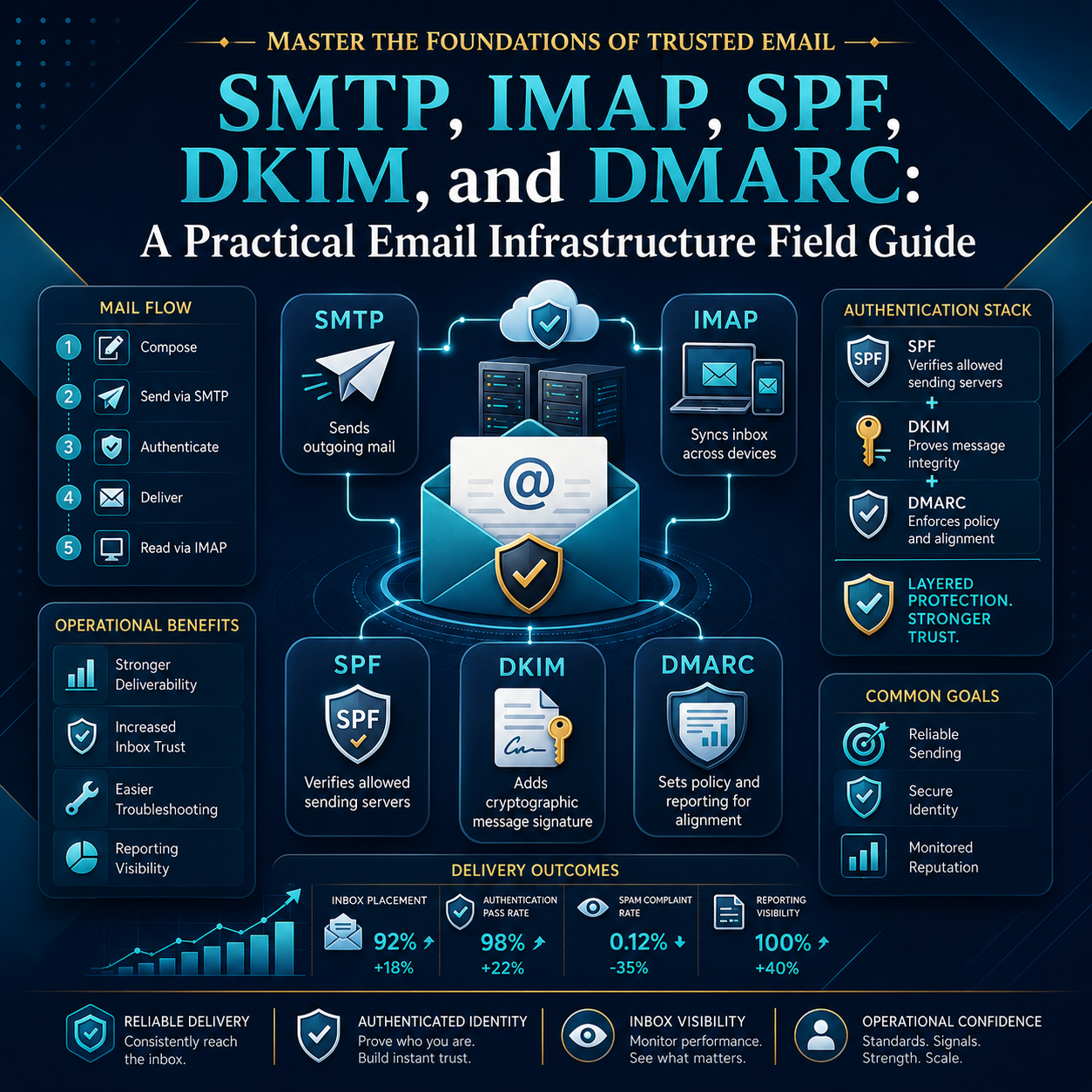
Email reliability is not one setting. It is a chain: the message is composed, submitted to an SMTP server, transferred between mail systems, authenticated against DNS, filtered by the receiver, stored in a mailbox, and later retrieved through IMAP or another access protocol.
SMTP sends; IMAP organizes and retrieves
SMTP is the transport protocol used to submit and relay email. A sending application normally authenticates to an SMTP submission service, negotiates encryption, supplies the envelope sender and recipients, and transfers the MIME message. IMAP is a mailbox access protocol. It lets a client synchronize folders, flags, message bodies, and attachments while the authoritative copy remains on the server.
| Layer | Primary job | Verification question |
|---|---|---|
| SMTP submission | Accept outgoing mail from an authenticated user or application | Do login, TLS mode, port, envelope sender, and rate limits match the provider? |
| SMTP relay | Transfer mail between servers | Are routing, reverse DNS, reputation, and retry behavior healthy? |
| IMAP | Synchronize mailbox content and state | Can the application read the expected folders without deleting or moving mail unexpectedly? |
| MIME | Package HTML, plaintext, and attachments | Are boundaries, encodings, filenames, and alternative parts valid? |
Authentication is layered, not interchangeable
SPF lets a domain publish which systems are authorized to use that domain in the SMTP envelope identity. DKIM adds a cryptographic signature to selected headers and the message body so a receiver can validate that the signed content survived transit and that the signing domain authorized the key. DMARC evaluates alignment between the visible From domain and authenticated SPF or DKIM identities, then lets the domain publish handling and reporting preferences.
A verification sequence that catches expensive mistakes
- Confirm the sending domain and visible From address.
- Verify SMTP authentication, encryption mode, port, and sender restrictions.
- Publish a narrowly scoped SPF record and avoid excessive DNS lookups.
- Create DKIM keys, protect the private key, publish the selector, and verify signatures on received test messages.
- Start DMARC in observation mode, review aggregate reports, correct alignment gaps, then strengthen policy deliberately.
- Inspect received headers at several mailbox providers rather than trusting a local “sent” status.
- Test replies, bounces, complaint processing, unsubscribe behavior, and IMAP synchronization.
Delivery status is not readership
An SMTP acceptance means the next server accepted responsibility for the message. It does not prove inbox placement or human reading. Open pixels can be requested by privacy proxies, link scanners, and automated security systems. Treat observations as technical events, preserve the surrounding metadata, and describe conclusions carefully.